Wu xing, usually translated as the Five Elements or Five Phases, names Wood, Fire, Earth, Metal and Water. In BaZi, the interesting part is not merely which word appears next to you. It is how these five categories relate, how their roles change with the reference point, and how a reading places them in context.
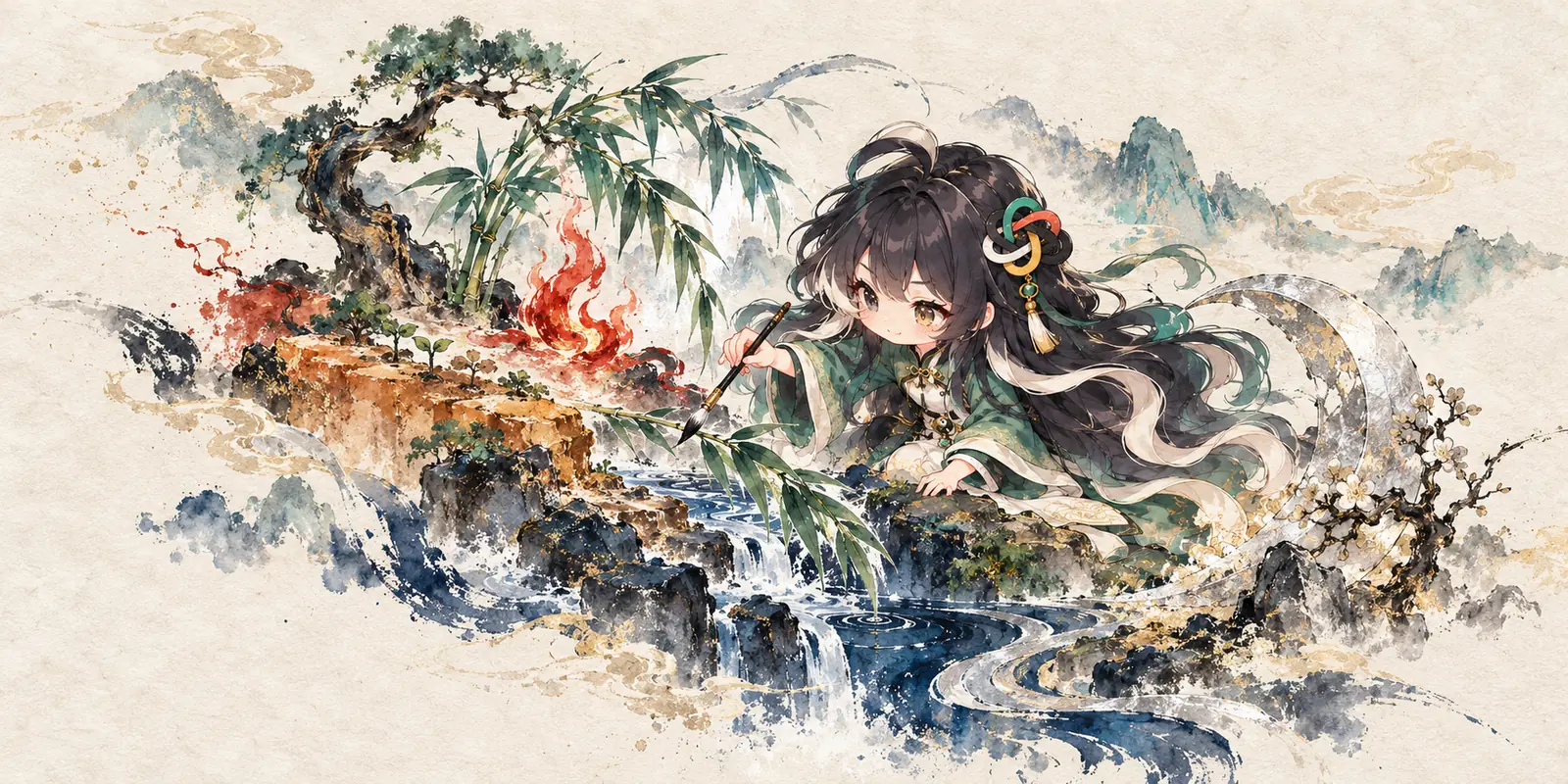
That can be easy to miss if your first encounter is a personality quiz or five colored bars. A chart with “more Fire” looks as if it should describe a more fiery person. A zero beside Water looks like a missing ingredient. The tradition has a more developed language than that: it works with directions of generation and control, seasonal conditions and relationships around the Day Master.
Start with the images, then follow the arrows. By the end, a sentence in a BaZi report should feel less like a mysterious label and more like something you can ask to have explained.
Five names with actions inside them
The “Great Plan,” or Hong Fan, chapter of the Book of Documents describes Water through moistening and descending, Fire through blazing upward, Wood through bending and straightening, Metal through alteration, and Earth through sowing and harvesting. These are explanatory paraphrases of the classical wording.
| Name | Image in the passage | What the image brings into view |
|---|---|---|
| Wood 木 | Bending and straightening | Form, direction and movement |
| Fire 火 | Blazing upward | Activity and ascent |
| Earth 土 | Sowing and harvesting | A process unfolding over time |
| Metal 金 | Being worked or altered | Transformation of form |
| Water 水 | Moistening and descending | Movement and effect |
Swipe to compare →
The passage belongs to a broader classical discussion, rather than a modern personality questionnaire. Its language concerns qualities and activities, not just five substances sitting in separate containers. The Art Institute of Chicago's Five Phases glossary also presents the framework through relationships with natural cycles and phenomena.
“Elements” and “phases” are therefore both terms you will encounter. You do not need to declare one translation forbidden. What matters for reading BaZi is that the English word does not erase movement and relationship from the concept.
The generating cycle: follow one step at a time
The familiar generating sequence is:
Wood → Fire → Earth → Metal → Water → Wood.
Here each arrow means “generates.” The “Meaning of the Five Phases” chapter of Chunqiu Fanlu states that order. It closes into a cycle rather than ending with one phase as the winner.
Some links are easy to remember through an everyday image: wood feeding a fire, or water nourishing a plant. Other links need the tradition's own explanation. The classical Wuxing Dayi, volume 2, collects several kinds of explanation, including material imagery and comparisons with social roles. The arrows do not all describe an identical modern chemical reaction.
Read a single link carefully before combining them. “Water generates Wood” names a directed relationship. Reversing the words changes the statement. “Wood generates Fire” gives Wood another position in the sequence: it receives from one phase and generates another.
Already, Wood is doing more than representing an adjective such as creative or flexible. It occupies a place in a network. That is the first move from an element label toward a BaZi reading.
The controlling cycle: a different set of arrows
The second common sequence is:
Wood → Earth → Water → Fire → Metal → Wood.
Each arrow now means “controls,” “restrains” or “overcomes,” depending on the translation. Wood controls Earth, Earth controls Water, and the sequence continues until Metal controls Wood. Wuxing Dayi discusses this order in its section on mutual control.
The two sequences answer different questions. Water generates Wood, while Metal controls Wood. Wood itself generates Fire and controls Earth. There is no contradiction: the name of the phase has stayed the same while its relationship changes.
“Control” can sound automatically hostile in ordinary English. In this vocabulary it names a relationship that still needs interpretation. It does not establish that a person with one element must dislike someone with another, or that a chart becomes better by removing everything that restrains its Day Master.
An arrangement can involve both support and limitation. The important question is what the reading says those relationships do together. Calling every generating arrow good and every controlling arrow bad would make the second half of the framework difficult to understand.
Put Wood in the middle and read all five relationships
For a BaZi example, suppose Wood is the Day Master's phase. This is a teaching reference, not a computed personal chart. The five categories can then be organized as follows:
| From Wood's perspective | Relationship | Broad interpretive family |
|---|---|---|
| Water | Generates Wood | Resource or support |
| Fire | Wood generates it | Output |
| Earth | Wood controls it | Wealth |
| Metal | Controls Wood | Authority or influence |
| Wood | Same phase | Companions or peers |
Swipe to compare →
The traditional Ten Gods terminology further distinguishes relationships through yin and yang. The Joey Yap tutorial on the terminology explains these relational families and why “god” is a translation used in this technical vocabulary, rather than a deity.
Now change the reference from Wood to Earth. Fire generates Earth, so Fire occupies the resource relationship there. Water, which supported Wood, is controlled by Earth and belongs to the Wealth relationship from that reference. The words have not become inconsistent; you have changed the point from which the relationship is read.
This is why “Water always means wisdom” or “Fire always means confidence” cannot substitute for a chart explanation. A symbolic association may be part of a teaching style, but it has not identified the role of that phase in a particular arrangement.
What a complete sentence adds to a diagram
Compare three increasingly developed statements:
“There is Water.” This identifies a category, provided the display says what it includes.
“Water generates the Wood Day Master.” This identifies a relationship and its reference.
“The reading discusses that relationship alongside the season, other components and the person's question.” Now the explanation has a context in which it can develop.
The third statement is not automatically correct because it is longer. Its value is that a reader can ask how the pieces connect. The traditional San Ming Tong Hui, volume 10, places the day stem within a method that also considers the month and the arrangement. It does not reduce the task to finding one attractive description per phase.
A five-bar count is useful for seeing what that display has counted. It cannot, on its own, supply the interpretation. Presence, strength and what a practitioner considers useful are different judgments. A more elaborate graphic still needs an account of how those judgments were made.
Why the season changes the conversation
In the traditional seasonal correspondences, Wood is associated with spring, Fire with summer, Metal with autumn and Water with winter; Earth has its own central and seasonal roles. Wuxing Dayi discusses these relationships together with changes in relative activity.
That gives a reader a reason to look beyond counts. The same number of Wood labels is not the whole traditional question if one chart is discussed in a spring setting and another in an autumn setting. The method considers conditions as well as categories.
These are the tradition's seasonal concepts, not a claim that someone born during rain must have more Water in their personality. Nor does moving to another hemisphere automatically justify rewriting a chart according to the weather outside. A reading should state the convention it uses.
For a beginner, the useful insight is modest but substantial: a phase is not read in isolation from the setting. You can understand that principle before learning every strength rule or special structure. It is a reason to ask for a developed reading, rather than an invitation to guess the final judgment yourself.
A modern question about support and expression
Consider a fictional writer who spends months studying and seeking expert feedback but struggles to finish a piece. No chart is assigned to this person. The situation lets us see what a modern discussion of traditional relationship words might explore.
A reading that uses the language of resources and output could develop questions about receiving guidance and making something public. Useful questions include what kind of support the writer actually has, what they produce with it, and what responsibilities affect the work. “You need more support” would be incomplete if the difficulty were turning abundant guidance into a finished draft.
Now imagine another writer rushing work into public view without the knowledge a particular project requires. The same general praise for output could miss a different need. Two people can bring similar words to a reading and need different conversations.
These examples are editorial illustrations, not conclusions derived from a chart or evidence that the Five Phases cause writing habits. They show what is gained when interpretation attends to relationships and circumstances. The vocabulary becomes more useful when it helps a person explain a tension, rather than merely admire a label.
Explore the relationships in your own FateWay reading
FateWay uses BaZi to connect birth-chart information with personal characteristics, relationships and time periods. Its interpretive approach brings traditional terms into modern contexts: support can involve learning or institutions, while responsibility can involve roles, rules and expectations. A report can become the beginning of a conversation about what those descriptions mean in your circumstances.
If you already have a reading, choose one sentence that uses an element or relationship term. You could ask:
“You describe support and expression in this section. Which parts of my chart are being related, and how does that interpretation connect to my experience of preparing carefully but hesitating to show the work?”
This is a suggested user question, not a generated answer. The point is to connect the chart, the interpretive step and an experience worth discussing. You can return to the same saved reading as that experience develops, rather than starting again with a new five-word identity.
If you want to begin that exploration, open a personal BaZi reading in FateWay. The full chart gives the five names a setting; follow-up questions give you room to understand the explanation. The reading offers a traditional perspective, while your choices remain grounded in the life you are actually living.
The first thing to keep is the grammar: what generates what, what controls what, and from whose reference point? Once those relationships are visible, Wood, Fire, Earth, Metal and Water can become a language for a connected reading instead of five boxes you must fit inside.